

In our previous Pressure Lab article (source), we showed that brand-new tennis balls are not always as fresh as players expect. This led to the next question:
What happens after you open the can?
Most players know that tennis balls lose pressure during play. Fewer people know that they also lose pressure when they are not being used.
For this test, we wanted to isolate that effect. We used the same set of balls from different brands and suppliers, stored them indoors at room temperature, and did not play with them.
We measured their pressure directly after opening, again after two weeks, and again after one month.
The results
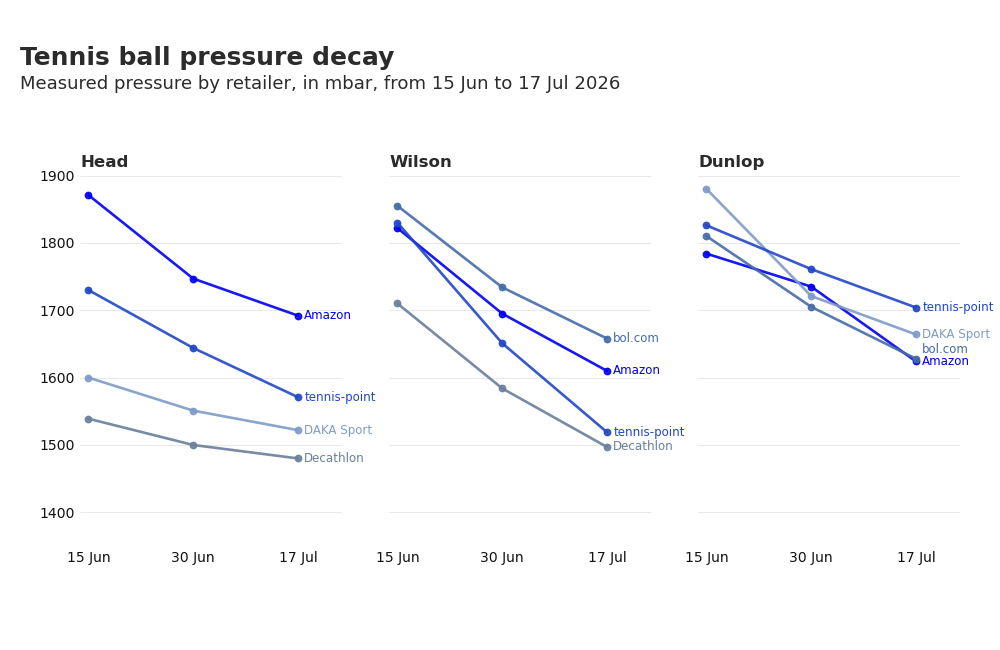
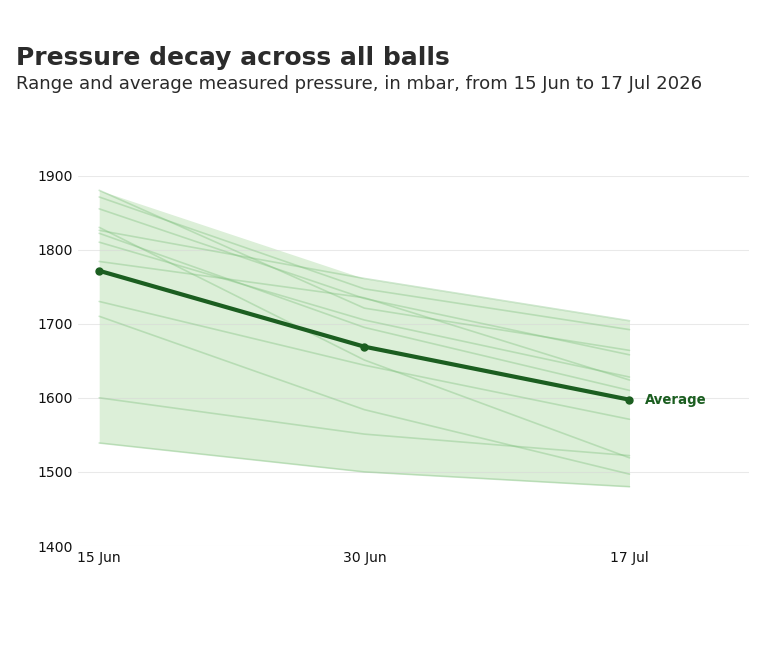
The pressure decay was visible across all brands and suppliers.
As shown in the previous article, the balls all started at different pressure levels. After opening, however, they all followed the same general trend: pressure started to drop over time.
As expected, the pressure loss appears to be proportional to the current pressure. Balls with a higher starting pressure lost more absolute pressure than balls with a lower starting pressure.
Over one month, the measured pressure loss ranged from 11% to 38%, with an average loss of 22.4%.
This means that, on average, a tennis ball lost almost one quarter of its pressure in just one month, without being played with.
What does this mean for players?
The main conclusion is simple: Opening the can starts the pressure loss process.
Even if you do not use the balls, they continue to lose pressure over time. So if you open a can, play once, and then leave the balls in your bag for a few weeks, they may already feel noticeably different the next time you step on court.
This also helps explain why some balls lose quality while the felt still looks fine. The balls in this test still looked almost new, because they had not been used, but they had already become softer.
What’s next?
This test only looked at pressure loss over time in unused balls.
In the next article, we will look at what happens when the balls are actually played with:
How much extra pressure is lost during play?
After that, we will connect the pressure data to the part that matters most on court:
How much does pressure loss affect bounce?
That is where the pressure measurements become directly relevant for your game.
Sources
Writer: Mirko van Donkelaar
17-7-2026